
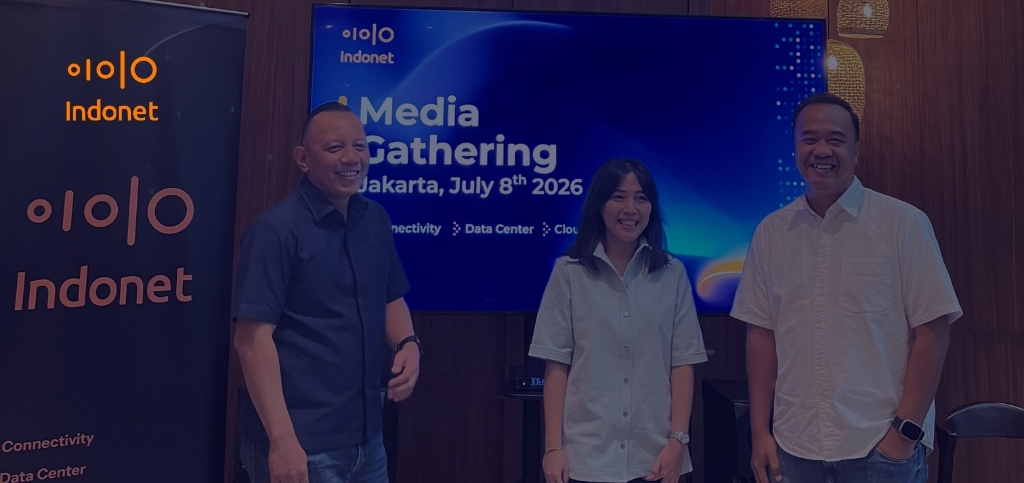
Jakarta, July 8, 2026 – Indonet is strengthening Indonesia’s digital connectivity foundation through the development of its East Route, an underground fiber corridor connecting downtown Jakarta with the industrial estates and data center hubs across Bekasi and Karawang. The East Route is part of Indonet’s Eastern Corridor development, which consists of three independent underground fiber routes. Following the launch of the first two routes in 2025, the third route is now officially operational, spanning more than 80 kilometers with 2 × 576-core fiber capacity.
With the addition of the third route, Indonet’s total fiber network has expanded to approximately 850 kilometers, representing 141% growth compared with its network footprint prior to 2024. The expanded infrastructure provides significantly greater capacity for future service expansion while strengthening inter-data center connectivity for customers requiring high availability, business continuity, and mission-critical digital operations.
Indonet is also among the first digital infrastructure providers in Indonesia to develop a fully underground fiber corridor connecting Jakarta with the industrial and data center clusters across Bekasi and Karawang. At the same time, the company has upgraded its Backbone Network to 100 Gbps to support growing connectivity requirements across industrial estates. This infrastructure enhancement aligns with Indonet’s continued network expansion into Indonesia’s strategic industrial growth areas, including the recently connected Mitra Karawang Industrial Estate (KIM).
As Indonesia’s data center ecosystem continues to expand, demand for reliable connectivity with high bandwidth, low latency, and high availability is increasing rapidly. In this environment, Data Center Interconnection has become a critical foundation for enabling fast and secure data exchange between data centers, ensuring uninterrupted business operations for organizations that increasingly rely on digital infrastructure.
“Indonesia is entering a new phase of digital infrastructure development. Investment in data centers, cloud, and AI will continue to accelerate, but the full value of these investments can only be realized when supported by equally robust connectivity infrastructure. That is why we continue to invest in underground fiber networks and reliable data center interconnection infrastructure, enabling our customers to grow with confidence rather than being constrained by infrastructure limitations,” said Donauly Situmorang, President Director of Indonet.
Beyond improving network reliability, investment in underground fiber infrastructure also strengthens long-term network resilience. Compared with aerial fiber networks, underground fiber provides greater protection against operational risks and external disruptions, delivering more stable connectivity for mission-critical applications such as disaster recovery and AI workloads that require consistent network performance.
Agus Ariyanto, Operations Director of Indonet, said the launch of the underground fiber route forms part of the company’s long-term strategy to build more resilient and sustainable digital infrastructure.
“We continue to invest in underground fiber because it offers a higher level of reliability than aerial fiber networks. Our entire network is deployed approximately 1.5 to 2 meters below ground, providing greater protection against external risks such as extreme weather and construction activities. This enables us to deliver more stable connectivity, strengthen network redundancy, and ensure reliable services for customers operating mission-critical applications,” said Agus.
According to the Indonesia Data Center – Market Share Analysis, Industry Trends & Statistics, Growth Forecasts (2026–2031) report published via GlobeNewswire, Indonesia is one of the fastest-growing data center markets in Southeast Asia. Supported by increasing investment from hyperscalers, cloud providers, and enterprises, the country’s data center market is projected to grow from USD 1.83 billion in 2026 to USD 3.48 billion by 2031, representing a compound annual growth rate (CAGR) of 13.71%. This rapid growth is driving increasing demand for reliable connectivity infrastructure capable of securely and efficiently connecting data center facilities across the country.
Yudie Haryanto, Sales & Marketing Director of Indonet, said the rapid expansion of Indonesia’s data center ecosystem must be supported by connectivity infrastructure capable of meeting increasingly complex business requirements.
“The growth of data centers is not only about adding more computing capacity. it also creates a growing need for fast, secure, and resilient interconnection between facilities. High-quality connectivity has become essential to maintaining application performance, ensuring service continuity, and enabling low-latency data exchange. Through the expansion of our underground fiber network and the upgrade of our Backbone Network capacity, Indonet is addressing these evolving requirements by providing reliable, scalable connectivity infrastructure that supports our customers’ business growth today and into the future,” said Yudie.
The strengthened network infrastructure also supports the continued development of Indonesia’s data center ecosystem, including the 500 MW CGK Campus in Bekasi, currently being developed by Digital Edge Indonesia. Together, Indonet’s connectivity platform and Digital Edge’s data center platform create an integrated digital infrastructure ecosystem designed to accelerate the growth of AI, cloud services, and Indonesia’s digital economy.